Poker Players Alliance News

[DC] Poker players lobby for online gaming

October 25th, 2007

Supporters tell members of Congress that the card game is one of skill and shouldn’t be restricted by U.S. Internet laws as are games of chance.

When trying to convince lawmakers that her career is more than just a card game, professional poker player Annie Duke refuses to fold.

“What I do is not gambling,” she said.

The world-champion player joined other poker hotshots lobbying Wednesday on Capitol Hill, hoping to persuade members of Congress that poker, like chess and mah-jongg, is a game of skill — and not, like roulette, a casino game that leaves players’ fortunes to chance.

Representatives of the Poker Players Alliance, an association of professional gamers and industry leaders with more than 800,000 members nationwide, contend that current federal online-gambling regulations violate international trade rules and unfairly restrict the civil liberties of poker enthusiasts.

“It’s a national pastime,” said Rep. Robert Wexler (D-Fla.), who opposes the current restrictions. “And the idea that we would prohibit adults from playing poker on the venue of the 21st century is illogical.”

Wexler has introduced a bill that would reverse restrictions on online poker bets by grouping poker with other skill games, such as backgammon and bridge. It would also allow state and federal governments to tax gaming transactions and implement safeguards to prevent play by minors and by individuals in states that ban Internet gambling. Rep. Barney Frank (D-Mass.) is sponsoring a similar measure that would provide broader regulation over all Internet wagering in place of an outright ban.

Last year, members of the Poker Players Alliance were trumped by enactment of legislation banning banks and credit card companies from processing payments to online gaming establishments based outside the United States.

Click here to go to article and read more.
[DC] Online poker players bet on changing laws

October 25th, 2007

In the evenings, Don Signore used to go to the local bar to play a few hands of poker. It was the kind of poker gathering where fathers sometimes brought their young daughters, and nobody played for money.

The night of cards with his new friends was a perfect distraction after his wife died two years ago, said Signore, who runs a Chicago catering business. “They take it very seriously. It’s about learning the game, it’s about becoming better,” he said.

But this month, the Illinois Liquor Control Commission shut down Signore’s league because under state law, an establishment with a liquor license couldn’t host poker, which the agency considered to be a game of chance and therefore illegal, even though Signore said his group didn’t play for money.

His frustration was enough that Signore came to Washington for this week’s Poker Players Alliance’s “fly-in” on Capitol Hill, where other poker aficionados lobbied lawmakers to ease federal restrictions on online poker playing.

Click here to go to the article and read more.

[DC] PPA Policy Forum in D.C. Packs Congressional Office

October 25th, 2007

The Poker Players Alliance continued its assault on Capitol Hill today with a forum featuring six men who talked to a room full of media, poker advocates, and congressional aides about the state of online poker in America and the current political atmosphere surrounding the game.

The hour-long forum, which was titled “Poker: Public Policy, Politics, Skill and the Future of an American Tradition,” lived up to its billing. The speakers touched on each of the subjects in the title, while news cameras rolled and Congressional aides furiously scribbled notes on large yellow legal pads.

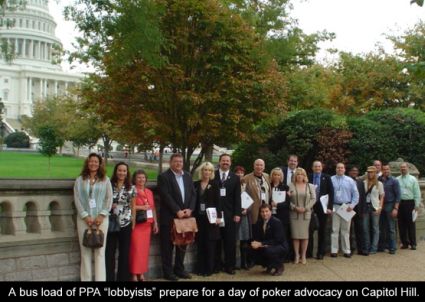
The forum was the main event of the two-day “fly-in” sponsored by the PPA. About 95 PPA members from states across the country showed up in Washington on their own dollars to learn how they could be active for the game of poker on a local level. Those members also attended the forum and met face to face with their regional members of Congress.

The PPA organized all of the meetings between PPA members and members of Congress, and John Pappas, the PPA’s executive director, was confident that the meetings did what he hoped they would do: give poker a face to the lawmakers and encourage them to support bills that would pave the way for regulation and taxation of online poker in America.

“It’s been tremendous. We’ve had nearly 50 meetings with key lawmakers,” Pappas said. “The pros have been a fantastic resource for us, but beyond that, just the ‘Average Joe’ poker players who have come out here and are participating in these meetings have made an impression on me that we have a real organization that is very interesting and can be politically motivated.”

Pappas and PPA lobbyists have been talking to members of Congress to try to convince them to support both Barney Frank’s bill, which would basically wipe the Unlawful Internet Gambling Enforcement Act (UIGEA) off the books, and Robert Wexler’s bill that would install a carve-out in the UIGEA that would provide protection for games of skill (poker included), but Pappas said it was imperative to match the PPA members with their representatives.

Simply put, when constituents talk with their specific members of Congress, the members of Congress listen more closely.

Click here to go to the article and read more.

Selected Coverage of the PPA DC Fly-In

October 25th, 2007

Read the rest of this entry »

PPA Fly-In Recap from John Pappas

October 25th, 2007

Wow! What an amazing three days poker had in Washington D.C. And the momentum is continuing to build.

From Oct 22 – 24, nearly 100 PPA members including some of the top professional poker players converged on Capitol Hill to meet with lawmakers and defended your right to play online poker. By all accounts the Washington Fly-In and policy conference was a huge success and we made a significant impression on Congress and the media.
Read the rest of this entry »

[DC] Internet poker players to Congress: We have rights, too

October 24th, 2007

America’s online poker enthusiasts descended on Capitol Hill this week with two messages for Congress: Poker’s good for the brain, and stop jeopardizing our games already.

The multiday lobbying visit by members of the the Poker Players Alliance, which counts more than 800,000 professional and amateur players on its rolls, arrived about a year after politicians enacted a restrictive anti-Internet gambling law.

The players’ goal for the fly-in: to boost support for a couple of bills, which so far enjoy support from only a handful of politicians, that would roll back those restrictions in favor of more tailored regulations. One proposal would expressly carve out poker from any ban on online gambling, placing it in a category with “games of skill” like backgammon, mahjong and bridge.
cards

“Certainly I think the growth of the game has been hurt,” Howard Lederer, a two-time World Series of Poker bracelet winner, said of the current law’s impact at a public forum organized by the PPA here Wednesday. He’s known as the “Poker Professor” for his commentary and analysis in card-playing circles and is one of the founders of the online card room Full Tilt Poker.

That’s unfortunate, Lederer argued, because “yes, it can be used as a vice, but for most of us it’s a wonderful form of entertainment that actually massages your mind, gets you thinking.”

To be sure, the online gambling bill doesn’t specifically outlaw online poker games nationwide. Congress’ intent was to clarify that forms of offline gambling already considered unlawful by state and federal laws are also illegal when shifted online. (Bets on horse racing, lotteries, fantasy sports and games that don’t involve exchanges of anything of “value” are exempt.)

The law requires banks and payment processors to take certain steps to block transactions stemming from “unlawful” forms of gambling and, in some cases, would force Internet service providers to block access to offshore gambling sites.

The trouble with that tactic is, it’s not always clear what forms of Internet gambling are “unlawful” from state to state–and how poker fits in.

With the risk of hefty fines and criminal penalties if they don’t do their part, payment processors seem to be playing it safe, opting to stop accepting transactions from online poker and bridge sites even when it’s not clear laws are being broken, poker enthusiasts said Wednesday.

Click here to go to the article and read more.

[DC] Poker Pros Bet Big on Lobbying Congress

October 24th, 2007

Coming off a resounding defeat in Congress a year ago, the country’s top poker players are trying their hand at a time-honored Washington parlor game: lobbying.

Nearly 100 leading card players are flying into the nation’s capital this week to urge lawmakers to roll back a ban on Internet gambling. They are led by Senator D’Amato, the New York lawmaker turned lobbyist who serves as chairman of the Poker Players Alliance.

The group is pushing a bill that would legalize and regulate online gambling through the federal government, effectively reversing a law that President Bush signed last year making it illegal for American banks and credit card companies to process online bets.

“We shouldn’t be making criminals of people who want to play poker in their own home. It’s ridiculous,” Mr. D’Amato said in a telephone interview.

The former three-term Republican senator brings added political clout to an industry that says it was broadsided by last year’s legislation, which was added to an unrelated port security bill and passed overwhelmingly. “They snuck the bill through,” Mr. D’Amato said.

The poker professionals in Washington this week include Chris Moneymaker, Howard Lederer, and many others who have become celebrities thanks to ESPN’s exhaustive televised coverage of the “World Series of Poker” events. They have scheduled dozens of meetings over two days with members of the House Financial Services and Judiciary committees, along with a public forum on Internet poker.

While Mr. D’Amato said this is the first organized lobbying effort by the group, he envisions the poker alliance having a much larger political presence in the months to come; he said he wants to create a political action committee and start voter registration drives.

“There is a growing constituency and a voice that cares about their ability to enjoy poker on the Internet,” he said. “We’re going to demonstrate to the members that this awareness translates into votes.”

Click here to go to the article and read more

[DC] Poker companies seek new hand on Capitol Hill

October 24th, 2007

You’ve got to know when to hold ‘em and know when to fold ‘em — and that means poker is a game of skill and not luck, a panel of lobbyists, academics and gamblers argued Wednesday on Capitol Hill.

The distinction involves a pot potentially worth tens of millions of dollars.

Federal law classifies poker as “a game subject to chance,” and for such games it bars the transfer of funds from a financial institution to an Internet gambling site.

That means online poker players can’t use credit cards — a major obstacle for the use of increasingly popular Internet gambling sites. While Internet gambling is illegal in the United States, offshore poker sites have used MasterCard and Visa as international modes of wagering.

Leaders of the Poker Players Alliance, claiming 800,000 members nationwide, visited congressional offices and sponsored the Wednesday’s forum in an effort to convince lawmakers to change the law. Professional poker champions Chris Moneymaker, Annie Duke, Howard Lederer, Barry Greenstein, Andy Bloch, Vanessa Rousso, Chris Brown and Victor Ramdin were among those making the pitch.

High-stakes card tournaments televised by ESPN have made national celebrities of many players of Texas Hold ‘Em and other poker variations.

“We’re poker players. We’re here to speak to our legislative representatives,” said Charles Nesson, a professor at Harvard Law School and founder of the Berkman Center for Internet and Society. The current law is “a disreputable piece of legislation,” he said.

The Poker alliance supports a bill sponsored by Rep. Robert Wexler, D-Fla., called the Skill Game Protection Act. It would exempt poker, mah-jongg, chess, bridge and other games where contestants compete against each other rather than the “house” from the Unlawful Internet Gambling Enforcement Act of 2006.

“Poker is a game, not a crime,” Wexler said. “Millions of Americans enjoy competing with each other in games of skill on the Internet.?We should protect the freedom of law-abiding adults to participate in these great American pastimes.”

These “games of skill” would not violate the federal law against “bets and wagers” on the Internet, Wexler explained. The current law already exempts horse and harness racing, fantasy sports and lotteries.

In a prepared statement, Wexler said his bill creates safeguards to prevent minors from participating in Internet gaming, excludes players in states that forbid Internet game participation, combats fraud and money laundering, provides assistance to persons with gaming addictions, and protects the privacy and security of persons engaged in these games.

Click here to go to the article and read more.

Internet Gambling Deserves a New Chance

October 24th, 2007

The U.S. should heed the wrath of the World Trade Organization by making betting games legal on the Web. Pro or con?

Pro: It’s Prohibition All Over Again
by Martin Owens, Gaming-Issues Attorney

The passage of the Unlawful Internet Gambling Enforcement Act (UIGEA) in October has led Antigua, which had previously sued America in 2003 before the World Trade Organization over the issue of Internet gambling, to seek relief before the world body once more. Chief among Antigua’s claims was that U.S. laws against Internet gambling constituted a trade barrier in violation of trade obligations.

Click here to go to the article and read more.

Con: This Vice Deserves No Encouragement
by Guy C. Clark, National Coalition Against Legalized Gambling

The U.S. government’s obligation to protect its citizens from a toxic, addictive product exceeds its responsibility to please the gnomes at the WTO.

Gambling addiction rises predictably with proximity of games and speed of play. Nothing is more proximate than a personal computer, and nothing works faster. Plus, the Internet adds the deadly element of anonymity. The neighbors won’t spot you at the virtual casino. Solid citizens with no previous criminal record commit outrageous crimes when addicted to gambling.

Click here to go to the article and read more.

[DC] Poker lobby plays its hand as ‘game of skill’

October 23rd, 2007

Poker might not be a sport, but it is a game
of skill. That’s according to the Poker Players Alliance, which is
mobilizing support this week to end federal restrictions against
playing for money online.

Nearly 100 of the PPA’s 809,000 members, from
professionals Annie Duke and Chris Moneymaker to former U.S. Sen. Al
D’Amato (R-N.Y.), will lobby legislators Tuesday and Wednesday for
changes to Internet gaming bills.

A federal law adopted last year, the Unlawful
Internet Gambling Enforcement Act of 2006, prohibits banks and credit
card companies from processing online gambling transactions, including
poker. The statute makes no distinction for games of skill.

“We want to demonstrate to the public, to the
members of Congress, that this is a game of skill,” said D’Amato, who
gave up his regular Monday night poker game to attend.

Click here to go to the article and read more.