

October 16th, 2007

- PPA UIGEA Talking Points
- Federal Reserve Web Comment
- Treasury Department Web Comment
- Other methods to comment
On October 1st, the Department of the Treasury and the Board of Governors of the Federal Reserve issued proposed regulations which, if finalized, would direct banks, credit card companies and other payment systems to take certain steps to block payments for “Unlawful Internet Gambling.” These regulations are an outgrowth of the Unlawful Internet Gambling Enforcement Act (UIGEA) which was enacted last October.
The proposed rule is subject to a 60-day public comment period, during which companies, trade associations and individual people have the chance to express to the regulators their feelings about the proposed regulation. PPA is encouraging its members to file comments with both the Dept. of Treasury and the Federal Reserve urging the regulators to exempt poker from the effect of the regulations, and to avoid adopting regulations that impact on personal privacy.
We urge you to comment in your own words — the regulators take individualized comments far more seriously than large numbers of obviously scripted comments. However, in an effort to help our members formulate their comments, we are providing the talking points below:
1. The proposed regulations should be modified to clarify that they don’t cover games predominantly determined by skill, such as poker, bridge, mahjong and backgammon. Section 5362(1)(a) of UIGEA defines a bet or wager as “the staking or risking by any person of something of value upon the outcome of a contest of others, a sporting event, or a game subject to chance,…” “Subject to chance” can be interpreted in a variety of ways, but in a gambling context it should reasonably be taken to mean games like roulette or slots where players bet against “the house” and success is determined by chance. Poker players compete, not against the house, but against each other, and the success of a player over any significant time interval is determined by that players’ skill.
2. The regulators must define what is and isn’t “unlawful Internet gambling.” The federal and state laws governing Internet gambling are very ambiguous — nearly all of them were written before the advent of the Internet, and it is not clear how they apply to Internet gaming. In the proposed rule, the regulators emphasize that it is not their intention to clarify this question, because to do so would require them to examine the laws of every state with respect to every gaming modality. Yet that is exactly what they are requiring every bank and payment system to do individually.
3. The regulators should refrain from implementing the regulations until the U.S. resolves its international trade disputes. The World Trade Organization has found the U.S. to be out of compliance with its obligations under the General Agreement on Trade in Services because of its attempts at prohibiting Internet gambling. This is likely to cost the U.S. economy billions of dollars in lost market share and export opportunities. The U.S. government is in negotiations with its trading partners over this matter. Inasmuch as these regulations arguably make that situation worse, the regulators should hold off on finalizing the regulations until the U.S. can resolve its international trade obligations.
4. The proposed regulations should not infringe on personal privacy. UIGEA deputizes banks and payment systems and turns them into the Internet morality police. These regulations should not compel banks to scrutinize the private transactions of individual poker players and others. To do so is hostile to the personal and financial privacy of every American with a credit card or checking account.
5. The UIGEA and the enforcing regulations should not apply to Internet poker nationwide. Federal case law has consistently held that the Wire Act applies only to sports betting and very few states have any laws against Internet poker. These regulations should be clear to only block those transactions which are in fact against the law. Games of skill which are not outlawed under current federal law – such as poker, chess, bridge and majong — should be exempt from the UIGEA and the regulations.
To send a web comment for:
Department of Treasury (click here)
Federal Reserve (click here)
The Federal Reserve
1. Go to the Federal Reserve UIGEA Comment Page.
Department of Treasury
1. Go to: http://www.regulations.gov
2. Then follow these three steps to access the Public Comment section on the UIGEA Regulations.
Step#1: Select “DEPARTMENT OF THE TREASURY *” in the drop down menu under “Optional”
(note: do not select “DEPARTMENT OF THE TREASURY – ALL”)

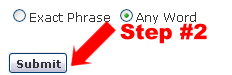
Step#2: Click the “Submit” button
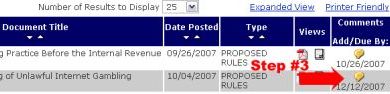
Step#3: Click the image under “Comments” for “TREAS_FRDOC_0001-0021 Prohibition on Funding of Unlawful Internet Gambling” to enter in your comments.
Other Methods to Comment:
Federal Reserve
You may submit comments, identified by Docket Number R-1298, by any of the following methods:
• Agency Web site: http://www.federalreserve.gov. (Live!)
Follow the instructions for submitting comments at:
http://www.federalreserve.gov/generalinfo/foia/ProposedRegs.cfm.
• E-mail: regs.comments@federalreserve.gov. Include docket number in the subject line of the message.
• Fax: (202) 452-3819 or (202) 452-3102.
• Mail: Jennifer J. Johnson, Secretary, Board of Governors of the Federal Reserve System, 20th Street and Constitution Avenue, N.W., Washington, DC 20551.
All public comments are available from the Board’s Web site at: http://www.federalreserve.gov/generalinfo/foia/ProposedRegs.cfm, as submitted, unless modified for technical reasons.
Accordingly, your comments will not be edited to remove any identifying or contact information.
Public comments may also be viewed electronically or in paper in Room MP-500 of the Board’s Martin Building (20th and C Streets, NW) between 9 a.m. and 5 p.m. on weekdays.
Department of Treasury
• Mail:
Department of the Treasury, Office of Critical Infrastructure Protection and Compliance Policy
Room 1327, Main Treasury Building
1500 Pennsylvania Avenue, N.W.
Washington, D.C. 20220.
Instructions: You must include “Treas-DO” as the agency name and “Docket Number Treas-DO-2007-0015″ in your comment.
In general, the Treasury will enter all comments received into the docket and publish them without change, including any business or personal information that you provide such as name and address information, e-mail addresses, or phone numbers.
Comments, including attachments and other supporting materials, received are part of the public record and subject to public disclosure. Do not enclose any information in your comment or supporting materials that you consider confidential or inappropriate for public disclosure.
You may view comments and other related materials by any of the following methods:
• Viewing Comments Electronically:
1. Go to http://www.regulations.gov
2. Select “Department of the Treasury-All” from the agency drop-down menu, then click “Submit.”
3. In the “Docket ID” column, select “Treas-DO-2007-0015″ to view public comments for this notice of proposed rulemaking.
• Viewing Comments Personally: You may personally inspect and photocopy comments:
Department of the Treasury Library, Room 1428
Main Treasury Building
1500 Pennsylvania Avenue, N.W.
Washington, D.C.
You can make an appointment to inspect comments by calling (202) 622-0990.
Tags: pressrelease2007