Headlines

Frank bill would repeal ’06 Internet gaming crackdown

By Jonathan E. Kaplan and Jessica Holzer, The Hill
Thursday, April 26th, 2007

Rep. Barney Frank (D-Mass.) will introduce legislation today that seeks to reverse a controversial crackdown on Internet gambling, which the Republican-led Congress passed in 2006.

While passing the bill will be difficult, there is a big financial incentive for Democratic leaders to pass it.

The chairman of the Financial Services Committee is looking to raise tens of billions of dollars with his new bill, which could be used to pay for expensive tax, healthcare, or other domestic legislation Democrats want to move this year.

The introduction of the bill and its expected movement in the 110th Congress shows how much has changed in the nation’s capital since the November elections.

With Democrats in the majority, the power of social conservatives diminished and new pay-as-you-go rules, supporters of a repeal believe the time to strike is now.

Frank, a longtime critic of regulating Internet gambling, opposes the law on philosophical grounds.

“It’s a terrible idea and there are a large number of people who think it is a terrible idea,” Frank said yesterday. “I don’t know how it ends. The worst that happens is that enough anti-gambling busybodies will be less inclined to interfere in people’s lives.”

Gambling lobbying groups were more than pleased by Frank’s announcement.

“We’re incredibly excited. I’m very interested in what the final version will look like,” Michael Bolcerek, president of the Poker Players Alliance, said. “But from what we understand, it will do the right thing for poker players and at the same time protect the public interest.”

The group, led by former Sen. Al D’Amato (R-N.Y.), was formed to overturn the  gaming law.
Frank believes that the GOP is hypocritical in saying it wants to reduce government intrusion but then passes legislation that regulates certain personal freedoms.

In 2000, Frank said, “It is important that people be able to do what the Republican Party wants them to do on the Internet. If the Republican Party has no objection, then they can do it. But if the Republican Party thinks there are pictures they should not look at, or perhaps booze they should not buy, or bets they should not make, then freedom for the Internet goes away.”

Because the law significantly affects the financial services industry, Wall Street is closely monitoring the Frank bill.

Friedman Billings Ramsey, an investment firm, wrote in a strategy memo that the Frank bill could raise more than $20 billion over five years.

The bill is expected to call for the Internet gambling industry to be taxed through a structured system.

Frank’s proposal, however, could face an uphill battle in the House, which passed the stand-alone measure 317-93 last summer. A less stringent version of the bill was later folded into a port security measure that was signed by the president last fall.

One source said that leadership officials in the House are on board with Frank’s plan, though Frank said he did not seek clearance from them.

Several members of leadership voted for the House bill last July, including Speaker Nancy Pelosi (D-Calif.) and Majority Whip James Clyburn (D-S.C.). Meanwhile, Majority Leader Steny Hoyer (D-Md.) voted no, as did Ways and Means Chairman Charles Rangel (D-N.Y.).
Republicans, who spent six years attempting to pass the Internet bill, are mobilizing against Frank’s effort.

“We’re going to fight it,” said Rep. Bob Goodlatte (R-Va.), a leading proponent of the crackdown on Internet gambling. “I’d be surprised if the new leadership would want to bring back an issue that took six years, because of one Jack Abramoff, to resolve.”

In 2000, then GOP lobbyist Abramoff, now a convicted felon, marshaled his conservative allies in the House to defeat a bill that included a ban on Internet gambling.

The law prohibits Americans from using credit cards and checks to play on-line poker, place bets and engage in other forms of gambling.

The proposed legislation could benefit the offshore gambling sites that saw their U.S. customer base disappear when Congress stepped in last year. Hedge funds helped to drive down their stocks in anticipation of the curtailment of online gambling.

The share prices of PartyGaming LLC and 888 Holdings, two online gaming companies that are traded on the London stock exchange, have fallen more than 50 percent since last year.
The stocks have started to claw their way back in recent months, as hedge funds and other investors came to believe the government would falter at stamping out such a popular online activity. PartyGaming has seen its stock roughly double in the past three months.  

Some U.S. companies also stand to gain from overturning the 2006 law, including Cryptologic, which provides software and services for internet gambling sites, said Andrew Parmentier, a senior analyst at Friedman Billings Ramsey.

Lobbyists for banks and credit card companies that would have shouldered much of the burden of enforcing the gaming crackdown, reacted favorably to Frank’s announcement.

“We’d be very pleased to see that law repealed simply because it would remove a potential burden on the financial system and especially on community bankers,” said Steve Verdier, the senior vice president for congressional affairs at the Independent Community Bankers of America.

“We also understand it will be a little bit of a road to get a repeal,” he added.

Bob Cusack contributed to this report.

The Hill (04/26/07)

Frank Introduces Internet Gambling Regulation and Enforcement Act of 2007

By House Financial Services Committee
Thursday, April 26th, 2007

Washington, DC – Rep. Barney Frank (D-MA) today introduced H.R.
2046, the Internet Gambling Regulation and Enforcement Act of 2007 that
would create an exemption to the ban on online gambling for properly
licensed operators, allowing Americans to lawfully bet online.

The Act establishes a federal regulatory and enforcement framework
to license companies to accept bets and wagers online from individuals
in the U.S., to the extent permitted by individual states, Indian
tribes and sport leagues.  All such licenses would include protections
against underage gambling, compulsive gambling, money laundering and
fraud. 

“The existing legislation is an inappropriate interference on the
personal freedom of Americans and this interference should be undone,”
said. Rep. Frank.

 In 2006, the House passed the Unlawful Internet Gambling
Enforcement Act, restricting the handling of payments by U.S. financial
institutions for unlawful forms of Internet gambling.  That law
prohibits the use of payment instruments by such institutions to handle
the processing of any form of Internet gambling that is illegal under
U.S. federal or state law. 

Traditional forms of legalized gambling already exist in nearly
every state.  By continuing to prohibit Internet gambling in the U.S.,
the U.S. has left Americans who choose to gamble online without
meaningful consumer protections. The proposed legislation would
institute practical and enforceable standards to bring transparency to
Internet gambling and provide consumers the protections they expect and
deserve. 

            The Financial Services Committee will hold a hearing
entitled, “Can Internet gambling be regulated to protect consumers and
the payments system?” at a date to be determined in June, 2007.

Q&A About the Internet Gambling Regulation and Enforcement Act of 2007:

LICENSE REQUIREMENTS

How will the government ensure that the proper consumer protections are put in place?

No applicant would receive a license unless the following
requirements with respect to any Internet bet or wager, at a minimum,
are met:

• Safeguards to ensure the individual placing the bet or wager is 18 years of age or older

• Safeguards to combat fraud and money laundering and compulsive gambling

• Mechanisms to ensure all appropriate taxes and fees are collected from individuals and the licensees

• Safeguards to ensure that the individual placing the bet or wager
is physically located in a jurisdiction that permits that form of
Internet gambling

What safeguards would be implemented to ensure that licenses are granted only to qualified Internet gambling operators?

Applicants for a license would be required to provide comprehensive
financial statements and corporate structure documents, and to agree to
be subject to U.S. jurisdiction and all applicable laws related to
Internet gambling.  No license would be granted to any applicant
convicted of a criminal violation of any law relating to gambling,
money laundering, fraud or other financial laws.  Licensing would be
handled by the U.S. Treasury through its anti-money laundering agency,
the Financial Crimes Enforcement Network (FinCEN).

CONSUMER SAFETY

How does the bill protect consumers?

The framework set forth in the bill would for the first time
effectively regulate Internet gambling, thus making it possible to
address underage and compulsive gambling, neither of which are
prevented under prohibition regimes.  Regulation combined with proven
technology would establish a system of effective controls to block
children and compulsive gamblers from gambling. 

How can restrictions against underage Internet gambling be enforced?

Existing technology can enforce requirements that licensed Internet
gambling operators restrict minors’ access to Internet gambling.  For
example, when registering at a gambling site, the customer would be
required to provide a range of information including name, address,
date of birth, telephone number and details of an identity document,
such as a driver’s license or social security number.  This information
would then be passed on to the Payment Service Provider (PSP) and run
through the Know Your Customer (KYC) system to confirm that the data
being provided matches against several separate sources of information
and is in fact accurate.  The operators may also have KYC systems in
place.

Operators could also request a physical copy of documentation, such
as a utility bill and/or a copy of the customer’s identity document,
for further verification. 

Is it possible to identify and enforce restrictions on compulsive gambling?

There are a number of techniques that can be used, from systems that
limit the total amount of funds that may be wagered based on credit
limits, to the use of public databases that include details used to
identify persons who have chosen to exclude themselves from online
gambling. Customers could be added to this list at their own request. 

Additionally, limits can be placed on the number of transactions a
customer can put through on a daily, weekly and monthly basis, by the
operator acting alone, by the credit card company, by the PSP, or by
all three.  In the event that an unusual spending pattern is noticed,
these transactions could automatically be put on hold for further
investigation.

FINANCIAL INTEGRITY OF INTERNET GAMBLING TRANSACTIONS

How will a license and regulation framework protect against money laundering and fraud?

Funds entering a gambling operator’s system are already resident in
the banking network somewhere.  That is, the funds have previously been
deposited into a bank account at some stage, subjected to stringent KYC
requirements, and which greatly increases the traceability of any funds
entering the system.  All transactions can also be checked at the time
of authorization against a number of anti-fraud, money laundering and
terrorism databases.

What additional security measures could be put in place to protect the consumer from merchant fraud?
Payment
Service Providers could set-up escrow accounts for each licensee in
which money is set aside for a period of time to ensure that when a
financial transaction is successfully contested the operator
immediately refunds the consumer.  Therefore, any claim regarding the
use of an unauthorized credit card could automatically result in a full
repayment to the principal credit card holder. 

STATES AND INDIAN TRIBES

Would individual states and Indian tribes have the option to opt-out of legalized Internet gambling?

To protect States’ and Indian tribes’ rights to control gambling
activities within their respective geographic borders, the Act permits
States and Indian tribes either to prohibit Internet gambling
activities or impose limits on various types of Internet gambling
activities. 

Is it possible for restrictions to be enforced if individual states
decide to “opt-out” from permitting persons in their states from
Internet gambling?

Yes.  In using the Internet, a customer’s IP address is broadcast to
the operator, which can then be used to identify the state in which a
customer resides with a 99 percent level of accuracy.  This information
is also made available and compared to the customer’s registration
information.  In the event the information differs, the transaction is
not approved and the customer is prevented from engaging in Internet
gambling. 

SPORTS BETTING

If professional sports leagues and college associations decide to
opt-out from allowing bets and wagers on their sporting activities,
could that be enforced?

Yes.  Under the proposed legislation, all licensed Internet gambling
operators would be prohibited from accepting bets or wagers on sports
leagues or associations that have opted-out.  In the event of a
violation, the operator’s license could be withdrawn and the operator
may be prohibited from applying for a new license.  As part of its
contract with the Internet gambling operator, the PSP would be required
to enforce these requirements throughout the collection and payment
process.

Democrat says expect online gambling bill Thursday

By Reuters
Wednesday, April 25th, 2007

WASHINGTON (Reuters) – House Financial Services Committee Chairman Barney Frank on Wednesday said he will introduce a bill this week to lift a ban on online gambling.

“Why anyone thinks it is any of my business why some adult wants to gamble is absolutely beyond me,” Frank told a community bankers group conference.

Frank, a Massachusetts Democrat, said he will introduce the legislation on Thursday.

Internet gambling in the United States was effectively banned last October when President George W. Bush signed legislation outlawing gaming financial transactions.

The ban irked some in the European Union, which is home to online gambling companies that were forced to withdraw from the United States.

Frank: Time to fold on online gaming law

By Patrick O'Connor, Politico
Wednesday, April 25th, 2007

Even seasoned gamblers love a long shot, so it’s no surprise that many will put their chips behind Rep. Barney Frank (D-Mass.) when the Financial Services Committee chairman unveils legislation to roll back last year’s crackdown on Internet gaming.

He is holding a press conference Thursday to discuss his bill, which he characterized as a blanket repeal of the enforcement mechanism Congress approved in 2006. Frank has been a vocal critic of the current law already this year, encouraging bettors of every stripe who were caught off guard by last year’s crackdown. But he does not plan to actively sell this bill on the Hill after he introduces it; instead, he will wait to see if outside groups can do that for him.

“I’m going to let the voters do this one,” the chairman said.

Frank and his backers face long odds in repealing the current law. The House approved its comprehensive enforcement update by a vote of 317 to 93 last year after a years-long struggle by a handful of Republicans to see it approved. Sen. Bill Frist (R-Tenn.) then inserted similar legislation into a port security bill as one of his last acts as majority leader.

Chat with Patrick O’Connor on Thursday at 12:30pm about Capitol Hill, the Iraq votes, and the online gaming ban.
Click here to submit your question.

Politico Live Chat

But Frist is no longer on Capitol Hill, and one of the authors, Rep. Jim Leach (R-Iowa), was defeated last fall.

The bill became law, in part, because Jack Abramoff and his team fought so hard to kill it. The taint of scandal does not hover over this legislation now that Abramoff is in jail after pleading guilty last year in a sweeping federal corruption probe that contributed to the Republicans’ demise.

At least two other Democrats are expected to introduce legislation to tweak the current law soon after Frank’s. Nevada Rep. Shelley Berkley plans to put forth a bill to pay for a yearlong study of gaming on the Internet that would delay the enactment of the current crackdown, and Florida Rep. Robert Wexler is expected to introduce another bill defining poker as a game of skill to create a carve-out for online poker.

Frank also has spoken with House Ways and Means Chairman Charles B. Rangel (D-N.Y.) about allowing the federal government to collect tax on every wager. Rangel himself is open to those discussions but has not advanced anything formal, a committee aide said.

Gamblers aren’t the only ones who favor a repeal of last year’s law. Many of the financial institutions that are now required to enforce the prohibition on gambling were quiet opponents of the legislation before Congress approved it. The new law sets guidelines for banks, credit card companies and other financial institutions to prevent them from transferring money to known Internet gaming sites. It also expanded the ability of federal law enforcement officials to monitor and prosecute those payments.

Frank has derided the legislation as unnecessary monitoring of an individual’s activities. He said the Republican-controlled Congress took a “Pecksniffian approach” to the issue, referring to the hypocritical do-gooder from Charles Dickens’ novel “Martin Chuzzlewit.”

Backing Frank on this effort is the Poker Players Alliance, a steadily expanding group of poker enthusiasts that is trying to protect the right to play poker at the state and federal level. The group saw a spike in membership after Congress approved new enforcement measures last year, said Michael Bolcerek, the president. The alliance now has more than 410,000 registered members.

The group distributes talking points, research and polling data to members on its website, and Bolcerek expects the organization to support Frank’s legislation, although he stopped short of a full endorsement.

“We’re excited to see what the bill looks like,” Bolcerek said. “We think this is good public policy.”

Advocates on the other side of the issue, particularly in the religious community, are also well organized and have worked for years to see the expanded enforcement mechanism become law. Sen. Jon Kyl (R-Ariz.), who helped write the legislation last year, sent a letter to President Bush in March urging him to ensure the regulations created in his bill would be fully enacted by the federal agencies responsible. “Proposed regulations may be released in the next few weeks, and weak regulations will embolden the Internet gambling industry to come roaring back onto U.S. shores,” Kyl wrote. “Only through strong regulations can the intent of the law be enforced.”

Overseas stock markets, particularly in England, took a major hit after the bill was enacted, losing an estimated $7 billion in market capitalization in one day, according to Kyl’s letter. Gambling outfits in those countries are eager to enter the United States for online poker and other Internet wagering because it represents a huge market.

For his part, Frank doesn’t make a distinction between poker, betting on horses or any other game of chance; it is all about individual rights.

“This is about freedom,” Frank said. “I’m not just concerned with poker. What’s next? Mahjong?”

Former Senator Battles Bet Ban

By Tony Batt, Las Vegas Review-Journal
Monday, April 9th, 2007

WASHINGTON — It wasn’t difficult for former Sen. Alfonse D’Amato to decide last month to lobby for the Poker Players Alliance as it seeks to repeal an Internet gambling ban.

“I’ve known some of the people at PPA and some, I actually played with. They knew of my enthusiasm for the game,” D’Amato said in a phone interview from New York City.

During D’Amato’s 18 years in the Senate, the New York Republican was known for having Thursday night poker games in his Capitol Hill office, and he still plays weekly.

After the House returns from a two-week recess on April 17, Rep. Barney Frank, D-Mass., chairman of the House Financial Services Committee, is expected to introduce legislation to repeal an Internet gambling ban approved by Congress last year.

Reps. Shelley Berkley, D-Nev., and Jon Porter, R-Nev., also plan to unveil a bill calling for an 18-month study of Internet gambling by the National Academy of Sciences.

D’Amato, 69, said he is working with Frank and the Nevadans, but it still isn’t clear how many bills will be introduced or when.

“We are not going to get into the pride of authorship,” D’Amato said. “We’re just working to produce legislative remedies.”

Poker players are being discriminated against by the ban, which does not prohibit state lotteries, fantasy sports or horse racing bets, D’Amato said. He describes the ban as an “unreasonable constraint” on the rights of individuals to use the Internet.

“Are we saying you have a right to own a gun in your own house, but you can’t use your computer to play poker on the Internet? It’s ridiculous,” D’Amato said.

The ban makes it a crime to use credit cards or online financial devices to pay for casino games and sports betting on the Internet.

Even though former Senate Majority Leader Bill Frist, R-Tenn., had to attach the ban to a port security bill in the waning days of Congress last year to get it passed. Repealing it will not be easy.

Roll call votes to ban Internet gambling were 317-93 in the House last July and 90-10 in the Senate eight years earlier.

The National Football League strongly supports the ban, and NFL Executive Vice President Joe Browne said Internet gambling is contrary to federal and state statutes.

“The spirit of Congress, going back for decades, has always been against gambling on college and professional sports,” Browne said.

As for D’Amato, Browne said, “he has always been a good spokesman for whatever cause he represents and he has been on the opposite side of professional sports on several occasions.”

D’Amato said Congress may have no choice but to consider a repeal after the World Trade Organization last week declared the ban illegal.

The WTO ruled in favor of Antigua and Barbuda, a Caribbean nation that defied U.S. efforts to outlaw the $12 billion Internet gambling industry. “I think, in the fullness of time, this (WTO decision) may be one of the linchpins in bringing about a change in the law,” D’Amato said.

After returning from a recent trip to the Isle of Man, which is located near Britain and allows Internet gambling, D’Amato said he is convinced online wagering can be effectively regulated.

Asked if Internet gambling should be regulated and taxed, D’Amato said, “Absolutely.”

Can Alfonse D’Amato Save Poker?

By Allyn Jaffrey Shulman, Cardplayer
Wednesday, April 4th, 2007

Former New York Senator Joins the Poker Players Alliance

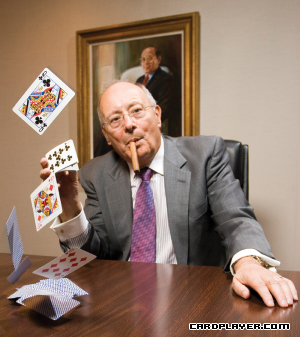
Score one for the good guys. Former New York Sen. Alfonse D’Amato
has graciously agreed to serve as chairman of the Poker Players
Alliance (PPA), to be its spokesman, and to lobby for a poker carve-out
to the Unlawful Internet Gambling Enforcement Act.

The PPA is a grass-roots organization comprised of more than 100,000
poker players and enthusiasts from around the United States who have
joined together to speak with one voice to promote the game, ensure its
integrity, and, most importantly, protect a poker players’ rights.

Who better than 18-year congressional veteran Alfonse D’Amato to lead
the fight? “Senator Al,” as he is affectionately referred to, is known
for such great accomplishments as requiring Swiss banks to return
billions of dollars to Holocaust victims; he is known for caring about
the needs of the individual constituent, and he is a fighter. He does
not shy away from a fight; rather, he will embrace the fight to protect
a poker player’s right to play online.
Senator Al posed a question: “What about the veteran who fought for
America and now is crippled and cannot get out? Why shouldn’t he be
able to play a little poker online and meet some friends? Only
ambulatory people can play poker? What a tragedy!”

He asked: “Is betting on horse racing any different than playing poker?
Why is there a horse racing exemption and a lottery exemption but
nothing for poker? Horse racing has a powerful lobbying group, that’s
all. They have a voice. Poker needs a voice, and a loud one!”

Sen. Alfonse D’Amato is poised to be just that voice.

In between Senator Al’s trips to Washington (where he is setting the
stage for change) and London (where he plans to educate himself
regarding UK online regulation), he and I met and chatted about the
future of poker and how he viewed his role in it.

Allyn Jaffrey Shulman: Welcome to the PPA. We’re very
excited to have you sit as chairman of the PPA board. Congratulations
on your unanimous appointment. Senator, when did you first hear about
the PPA?

Alfonse D’Amato: In October. I heard about the PPA from Wayne
Berman, a friend of mine who was my partner at one time, and who was
also in our regular Thursday night game, every other week. He mentioned
to me that the PPA existed.

I thought that the legislation being proposed was using a cannon to
kill a gnat. What really needs to happen is to have a legitimate house,
a fair game, and a fair operator, and not take away from
20-plus-million citizens who play poker the opportunity to play poker
on the Internet. Why should they be deprived of Internet play and …

(Interruption: Gov. Arnold Schwarzenegger is on the phone …)

AJS: I understand that you have two different roles in the PPA. Besides being chairman of the board, what is your other role?

AD: Well, after serving in Congress for 18 years, in 1999, I
began Park Strategies LLC. My role in the PPA includes myself and my
firm. We will be lobbying to reform the UIGEA. Although the Act was
well-intentioned, it will fail to achieve its goals. We all want to
protect kids; we don’t want money laundering, and we don’t want our
citizens cheated. But, we don’t want to waste our resources, either.

Our strategies will include getting Congress to reconsider the impact
of the Act. What we want to get them to consider is that now, instead
of getting controls over people who are underage, those who don’t care
about that are replacing the public companies who have good business
practices, and there will be no safeguards. We should say, let’s deal
with mechanisms to curtail youngsters, make sure they don’t play, and
make sure reputable operations are taking place.

Of course, assigning to the authorities the tracking of terrorists and
money laundering is an important task. Enforcing this legislation is a
diversion of tremendous assets! Drug cartels and illegal transferring
of money are serious issues. This legislation may be well-intentioned,
but it misses the point. The revenue that could be derived and used in
other areas of law enforcement is something that needs to be addressed.
Regulation in this area, which would include different safeguards, is a
more well-reasoned course of action. And, of course, the revenue that
it would bring in would be so much better than the revenue that is now
being spent to enforce the Act. We would be getting money to be spent
in important areas, rather than spending money where it doesn’t need to
be spent.

AJS: Why are you and the PPA such a good fit?

AD: Well, I am fairly accomplished in legislation. I have
maintained good relationships with both sides of the aisle, and
hopefully I can get Congress to listen. We shouldn’t drive the industry
underground. If we cut off major banks, there will be others who will
operate offshore, and may not be honorable. What will happen with no
safeguards at all?

Poker is a game of skill that should be allowed to be played online.
Betting on horse racing involves no skill … but in poker, there is
skill. What about lotteries or fantasy football? Tell me about the
skill level in fantasy football. And what do they do to protect young
kids in those areas? Now, if you want to say that it’s to protect kids,
do it properly; don’t drive the industry offshore, where we have no
regulation and no controls.

It’s just like Prohibition. No one says drinking is great; anything in
excess can be a problem. You can’t stop drinking and you can’t stop
gambling. And if we really wanted to stop gambling, what about casinos?
Gambling isn’t going to stop. People aren’t going to stop. Why allow
only casinos? Only ambulatory people can play poker? If a person is
confined and doesn’t have a way to get out, they’re precluded. That is
terrible! What a tragedy! Someone can’t get out or can’t get a ride,
and they are deprived? And by the way, what about the opportunity to
meet other players and socialize with them online? There is an element
of unfairness here.

AJS: How big do you think the PPA has to be to have an impact on our government?

AD: I think it has to grow in size and grow in voice! That voice
must say that we want you to regulate and not ban. Protect citizens!
Ensure safety! Make sure that people are not being taken advantage of.
England has been doing this for a long time. 20-million-plus Americans
play online poker.

Last year, the World Trade Organization indicated that we may be in
violation of WTO agreements. We’re discriminating against other
countries. Inevitably, we will be held not in compliance, and penalties
will be levied against us. We need to regulate. There is an upside.
Knock out unscrupulous houses. Regulate. Protect kids and those who are
vulnerable. It is not onerous, because having a licensing procedure
will pay for itself. The burden and expense would not be on the
government. Tax revenues and the licensing procedure will pay the cost.
Instead of the government paying out money to try to stop millions of
Americans, we should see to it that the industry is regulated, and
bring in money.

AJS: Do you think in 2007 that we have the ability to obtain a poker carve-out to the UIGEA?

AD: I think you never give up. You set the stage. I’m not going
to say that it’s going to be easy, or that it cannot be done. But I
don’t want to give a false impression. I intend to go to people who
sponsored the legislation and educate them. Go to people you might not
think would support a carve-out. Give them a reason to make a better
bill, accomplish a better goal. Don’t waste law enforcement resources.
Provide safeguards. I was down in Washington yesterday to begin the
process of education and answering questions. We will have to come up
with effective answers that satisfy the concerns that we all have. That
can be accomplished by effective regulation.

AJS: What are our biggest roadblocks?

AD: Well, I think convincing legislators that there is a better
way to do what they want to do. They were acting under a number of
influences. Interests in Las Vegas and sportsbooks wanted this
legislation. Under the guise that gambling is bad, they came up with
this all-encompassing area. Horse racing was left off because of the
power of the industry! We need that same power in the poker industry.

AJS: What can the average poker player do to help?

AD: Reach out to friends. Join the PPA. Write to Congress. Call
your senator. Don’t give up. We need a strong presence – loud voices.
Why should the industry be driven underground like Prohibition? Ensure
that it’s a fair game! Why should I be deprived? Why can’t I use a
legitimate bank? I want regulation! Make your voices heard!

AJS: What can poker sites, software companies, and the media do to help?

AD: I think the media has to talk about the inequality. Horse
betting is OK. Lotteries are OK. If you have an addiction to horse
racing, it is inconsistent to say that we will stop one group. If we
are saying that Texas hold’em is bad, what about casino gambling? We’re
kidding ourselves if we think that we are going to stop the popularity
of online gaming. We’re not going to stop people from playing; you will
only get unscrupulous groups to replace public companies. We are losing
the opportunity for revenue by regulation. There will still be an
industry. Big companies will continue to leave, only to be taken over
by the underworld. That doesn’t make sense.

AJS: American Gaming Association President Frank Fahrenkopf told
me that he doesn’t think a carve-out will happen, and that instead, a
feasibility study should be done to determine whether regulation is an
option. What do you think about regulating online poker?

AD: I’ve known Frank for 25 years. He’s a wonderful guy, but he
doesn’t really care; if he wanted to help get a carve-out, he could
help. A study will cause two years of inaction. Then, we will study the
study. Then, we will discuss the study. And while we are busy studying
the study, the industry will be driven underground.

AJS: Many people are outraged about the way the UIGEA was snuck
through Congress at the 11th hour. First, is that an ordinary tactic?
Next, were you offended, as well?

AD: It was a sneak attack, and former Majority Leader Bill Frist
should be ashamed of himself. Now, Senator Kyl, who supported the Act,
is a decent, caring, honorable man, on either side of the aisle. But
for the majority leader to stop debate was abuse of the great authority
given to him, by attaching it to a bill that had to pass. He
did it not so much that he thought online gaming is horrendous, but to
carry favor with the Christian right. That is an abomination!

He did the wrong thing to attempt to advance his political career, and it backfired on him.

AJS: There was talk that Frist agreed to get the UIGEA passed if
Jim Leach would get Iowa to support Frist for president. Did you know
anything about that?

AD: I heard the rumor that Frist agreed to get the bill through
and he was looking for support. I don’t know if it’s true, but connect
the dots …

It’s pretty ironic, isn’t it? There’s a good chance that Leach was defeated because of poker players’ outrage.

AJS: Do you think that a Democratic Congress has a better chance of passing a carve-out than the previous Congress?

AD: The nature of fighting for an issue like poker doesn’t
initially gain much support. We have to go about it by demonstrating
that it is better to have controls and safeguards as it relates to
poker, rather than attempt to ban and not have any ability to control.
We have to educate members of Congress, get them to think about the
issue differently. They all know cons. How about the pros? Do we
regulate? Yes. Are we using resources to enforce the new law? Yes.
Could the money be better utilized? Yes. We can better use that money!
Do we want to build up a multibillion-dollar industry with less than
reputable people? No. Let’s exercise patience, perspicacity. (AJS
interrupts: “Good word!” He spells it for her: p-e-r-s-p- … “My
spell-checker already got it right!”)

Churchill said never give up. It’s not going to be easy. I took a trip
to Washington yesterday to begin speaking with some of my colleagues.
Today I am taking a trip to London to become more knowledgeable about
licensing. Also, if Congress sees that the WTO is going to enact
penalties, this may move us into compliance.

AJS: I am sure that you have heard of the new law that passed in
the state of Washington in June of 2006, making it a Class C felony to
play poker online. (Class C felonies carry a maximum penalty of five
years in prison and a $10,000 fine, just like certain types of rape and
child molestation.) What do you think about criminalizing online poker?

AD: What? We’re going to arrest doctors for playing poker online? It’s outrageous!

AJS: What the heck is going on in this world of ours, where a poker player can be punished as harshly as a rapist?

AD: Nintey percent of Congress probably was not aware.
They were told that people would not be prosecuted. Justice couldn’t
allow this.

(At about this time in the interview, Senator Al apologized and
explained that he had to catch a plane to London and didn’t want to be
dressed in a suit, so he started taking his tie and shirt off. His
lovely assistant, Dana, came rushing in and pointed to my computer,
saying: “Write about that!” I told her that I couldn’t because my eyes
were closed.)

AJS: Many people assume that Republicans are opposed to
online poker, although I imagine it’s only the ultra-right Republican.
How do you square being a Republican and supporting online poker?

AD: Trying to be Big Brother flies in the face of being a
conservative Republican. We have lost our principles. We don’t want
people to play poker, but it’s OK to bet on horse racing? We won’t
provide the same opportunity? It is inconsistent. It was the same thing
with Prohibition. We will legislate, so you cannot drink? The policy is
flawed, because it doesn’t work.

Will we prosecute millions of people for playing poker but not for
horse betting? This hypocrisy brings about contempt. It brings about
disrespect for the law and disdain for the lawmakers.

AJS: What do you think about the recent arrests of the two former NETELLER executives?

AD: Well, ya know, they aimed guns at the big guys and it had
its impact. We took a reputable company and ran it out. They no longer
provide a needed service. They ran out a public company and left the
door wide open for some unscrupulous group. It is better if NETELLER is
back in the U.S.

AJS: What about the money belonging to U.S. citizens that NETELLER still has?

AD: Yes, something like $90 million. It’s a shame. They’re
afraid to pay out the funds. And the federal government has put a hold
on that money. I hope people get their money back. They are innocent
victims.

AJS: I’d like to ask a few personal questions. Will you describe some memorable moments in your 18 years in Congress?

I read that you once filibustered for more than 23 hours against a
military bill, and another time, in order to protect 750 jobs of New
Yorkers, you sang South of the Border (Down Mexico Way). Would you tell our readers about that?

AD: Well, that’s where the jobs would go. That was a
midnight bill that snuck through. I tried to kill it by not letting
them vote. After 23 hours, a lot of people just go home. At the end of
the period, we lose a quorum.

Smith-Corona planned to move 875 jobs from its upstate New York
typewriter factory to Mexico, to save wage costs so that it could
compete against low-priced Japanese imports. So, I sang South of the Border (Down Mexico Way). I wanted to protect jobs.

AJS: And I remember that you were instrumental in getting Swiss banks to give money back to Holocaust survivors.

AD: I felt very good about my part in facing the Swiss banks and
getting restitution for the Jewish community. I helped to get 1.25
billion dollars back. I led the battle to get that money from Swiss
banks, kept from Holocaust survivors. Those are moments I enjoyed very
much.

Eighteen years gave me a chance to fight for the little guy and for my
state. I was privileged to have that experience. Serving with the great
Ron Reagan was fantastic. He was one of the great human beings.

AJS: How did you get the name “Senator Pothole”? Are you proud of the nickname?

AD: I got it fighting for the little guys. Initially, it was
pejorative, but then I made a difference for people. I embrace that
name as a badge of honor.

There was a highway where people were getting killed, a deathtrap:
Route 17, which is now called I-86. It needed to be bigger, safer. We
got the federal government to put money in, and we saved countless
lives.

AJS: Well, senator, I have to ask. Are you a better poker player or a better lobbyist?

AD: I would hate to make a living playing poker. I would be on food stamps!

AJS: Senator, you are a charming man. Thank you so much
for your time and for agreeing to fight the good fight. Is there
anything else you would like to say about your new role as spokesman
for the Poker Players Alliance?

AD: I am pleased and privileged to be the spokesperson for
the PPA. I don’t know all the answers, but I am going to learn.
Probably, people feel alienated, and I want to know about it. I want to
use the information I learn. We are going to set up a website to be in
contact with the people. I want to know how they feel and I intend to
do something about it. This is not just about poker; it is about
protecting personal freedoms.

And so it was on a chilly New York day on Park Avenue that Sen. Alfonse
D’Amato discussed his plans to be the needed spokesperson for the PPA
and fight for the rights of poker players. It’s not just about playing
poker; it is about protecting personal freedoms. spade

WTO Ruling Sparks Debate Over Online Gambling

By Michael Martinez, National Journal's Tech Daily
Monday, April 2nd, 2007

Opponents of a federal law curtailing online gambling have their fingers crossed that a recent international trade ruling will prompt lawmakers to undo the statute.

The World Trade Organization decided last week that the United States has violated international trade law by prosecuting online gambling cases while still allowing online bets for horse-racing and, in some states, lotteries. The WTO ruling sided with a complaint filed by the tiny island nations of Antigua and Barbuda, which depends economically on e-gambling.
    
Lawmakers in the 109th Congress authorized legislation to effectively bar the financial industry from processing payments to online gambling sites. The measure cleared the Senate after it was attached to an unrelated port security bill by former Majority Leader Bill Frist, R-Tenn.
    
The Poker Players Alliance, which lobbied hard last session against the measure, is now trying to convince Congress to reverse it. Former Sen. Alfonse D’Amato, R-N.Y., the group’s new chairman, said the WTO ruling is only the beginning of a global blowback against the U.S. on the e-gambling front.
    
According to D’Amato, it would be much wiser for the United States to allow online wagering and regulate online bets than criminalize it. He said the PPA is going to continue to push for a revocation of the law and to educate lawmakers on why it was a bad idea.
    
“They’ve used a cannon to kill a gnat,” D’Amato said.
    
He said the United States should be taking its cues from England, which has explicitly allowed online bookmakers to operate there.
    
Reps. Shelley Berkeley, D-Nev., and Jon Porter, R-Nev., are expected to introduce legislation that would commission a study on how online gambling could best be regulated. They offered a similar bill last session before anti-gambling legislation cleared the House.
    
House Financial Services Chairman Barney Frank, D-Mass., said last month that the anti-gambling measure cleared by 109th Congress was one of the “stupidest” laws ever passed. He told the Financial Times that he is considering ways to repeal the law.
    
Frank spokesman Steve Adamske on Monday said any legislation coming out of the office is still in the planning stages. He said the WTO ruling would not affect Frank’s opinion on whether outlawing online gambling is impractical. 

“The question is whether it changed anyone else’s opinion,” he said

Poker enthusiasts seek to legalize public wagering in Texas

By Kelley Shannon, Associated Press
Monday, April 2nd, 2007

AUSTIN — Poker players who now attend illegally organized card
games would get to take part in legal, licensed Texas Hold ‘Em wagering
across the state under a proposal the Legislature is considering.

The
bill by Rep. Jose Menendez, a San Antonio Democrat, would allow live or
electronic poker gambling at certain establishments as well as
charitable poker for qualified groups.

Poker enthusiasts,
including some leading national players, are expected at the Texas
Capitol on Tuesday for a hearing on the proposal before the House
Licensing and Administrative Procedures Committee.

If
enacted into law, the measure would put Texas alongside several other
states such as California and Montana that created a safe, regulated
environment for poker wagering, said Michael Bolcerek, president of the
National Poker Players Alliance.

The Texas proposal calls
for allowing the card game Texas Hold ‘Em, which Bolcerek describes as
“the granddaddy of poker.” Its rules provide several opportunities for
players to bet and bluff their opponents.

“It’s one of the
most difficult games to play and requires a consummate amount of
skill,” said Bolcerek, whose alliance has more than 20,000 members in
Texas.

That necessary skill makes poker more a “sport” and
sets it apart from other gambling games that rely mostly or solely on
chance, according to Bolcerek and other supporters of the bill. The
bill states that poker is not a lottery game prohibited under the Texas
Constitution.

Existing Texas law allows gambling on a card
game if it is done in a private place, such as a home; if no one
received economic benefit from the game other than personal winnings;
and if the risk of winning or losing is the same for all participants,
according to the Texas District and County Attorneys Association.

Poker
enthusiasts say businesses illegally organize games now, and all types
of people are playing, from grandmothers to lawyers.

Opponents of Menendez’s bill so far haven’t been vocal.

“I
don’t understand why anybody would oppose creating legal, regulated
gaming that provides revenue for all Texans,” Bolcerek said.

Under
the proposed legislation, the Texas Lottery Commission would rule on
where poker tables would be allowed, such as bars or race tracks. The
state and the business establishment would get a cut of the action.

There has been no fiscal analysis of the bill yet by legislative researchers.

Establishments
with liquor licenses would be prime spots for poker wagering because
those businesses will have gone through the vetting process required
for alcohol sales, said Mike Lavigne, treasurer of the Texas Poker
Coalition, a political action committee.

Sexually oriented
businesses would not be allowed to host games under an updated version
of the bill expected to be introduced, Lavigne said. Penalties for
illegal games would be toughened, he said.

The proposal does not address Internet poker playing, which Lavigne calls a federal issue.

The
Texas Gaming Association, a group of major casino industry officials
pushing for destination resort casinos in the state, isn’t taking a
position on the poker proposal. Poker games and casino gambling are
separate issues, said association lobbyist Chris Shields.

Lavigne said he expects there may be some opposition from conservatives who have opposed gambling expansion in Texas.

But,
he said, poker is more pervasive in society than casino games like slot
machines, and poker players are competing with each other, not the
“house,” the business hosting the game.

Another bill before
the House committee by Rep. Norma Chavez, D-El Paso, would legalize
charitable “poker runs” by motorcycle clubs and other groups.

A
poker run is when paying participants ride motorcycles to certain sites
along a prescribed course to collect a playing card. Those with winning
poker hands may receive cash or other prizes.

Attorney
General Greg Abbott ruled in 2005 that such events violated state law
because they promoted gambling. Chavez’s bill would change that
provision and allow poker runs by charities.

___

The poker legalization bill is HB 3186.

Gambling interests spend millions in lobbying

By Diana Marrero, Gannett News Service
Friday, March 30th, 2007

WASHINGTON — Casinos, Indian tribes and other
groups spent millions lobbying Congress last year as lawmakers
considered bills to ban wagering online and off Indian reservations.

The industry is expected to spend millions more this year as those issues heat up again in Washington.

The $25 million the gaming industry spent on
lobbying in 2006 was a slight increase over the previous year’s total,
but down from the $28.5 million spent four years ago. Overall,
companies, associations and other groups spent $2.5 billion on lobbying
in Washington last year, with the pharmaceutical industry topping the
charts at $166.5 million.

The spending came amid controversy over public
corruption scandals involving convicted former lobbyist Jack Abramoff,
who admitted to bilking wealthy American Indian gaming tribes.

“Even though we didn’t have anything to do with
it, we all tend to get labeled,” said Frank Fahrenkopf Jr., president
of the American Gaming Association, which spent $900,000 last year
lobbying on behalf of commercial casinos.

Still, the gambling industry fared pretty well
in Washington, he said. And he expects casinos will do even better this
year because of a new cast of leaders in Congress who understand the
industry.

They include Senate Majority Leader Harry Reid,
a Nevada Democrat who has been a strong casino advocate; Rep. Charles
Rangel, D-N.Y., chairman of the House Ways and Means Committee; and
Rep. John Conyers, D-Mich., the House Judiciary Committee chairman.

The industry also has Republican allies in
powerful posts, including Sen. John Ensign, a Nevada Republican, who
now heads the National Republican Senatorial Campaign Committee.

Much of the gambling industry’s 2006 lobbying
centered on legislation to ban online betting. The measure became law
after former Senate Majority Leader Bill Frist, R-Tenn., inserted it
into an unrelated bill passed late last year.

Internet gaming supporters want lawmakers to reverse the ban before some of the regulations go into effect this summer.

The Poker Players Alliance, which lobbied
heavily against the ban recently hired former New York senator and
poker enthusiast Alfonse D’Amato to lead the group’s effort this year.
D’Amato’s message to former colleagues: the U.S. government could
generate $3 billion in taxes a year if it regulated the industry.

“There are millions of Americans who love poker
and who feel strongly their rights were taken away in the last
session,” said Michael Bolcerek, president of the Poker Players
Alliance, which paid another lobbying firm $540,000 last year to work
against the bill. “It’s an overreach of the federal government that
needs to be rectified.”

The alliance already has some support in
Congress for repealing the ban. Rep. Barney Frank, D-Mass., chairman of
the House Financial Services Committee, told The Financial Times last week that the Internet gambling ban was one of the “stupidest” bills ever passed.

Meanwhile, two Nevada lawmakers, Reps. Shelley
Berkley, a Democrat, and Jon Porter, a Republican, are drafting a
proposal to study ways to regulate online gambling.

Gaming experts question whether the issue will gain any traction.

“It’s a subject the public cares somewhat
about,” said Robin Hanson, an economics professor at George Mason
University who studies the gambling industry. “But they’re not
overwhelmingly passionate about it.”

Hanson says it’s usually more difficult for
Congress to repeal anti-gambling measures than to pass them because
it’s the kind of issue most politicians don’t want to promote.

“Usually, the way gambling grows is by neglect,” he said.

Although efforts to ban off-reservation gaming
died in Congress, the Interior Department is considering regulations
that could restrict development of new Indian casinos on
off-reservation sites.

Dozens of tribes who want to build casinos — in
some cases hundreds of miles from their reservations — are lobbying
against the rules. But many wealthy gaming tribes support new
regulations, saying the practice has led to “reservation shopping.”

Tribal governments are also monitoring the
actions of the National Indian Gaming Commission, which wants to make
bingo machines used in certain Indian casinos work slower so they won’t
resemble Las Vegas-style slot machines.

Despite the high-stakes measures affecting
Indian casinos that Congress considered last year, the $16 million
tribes spent on lobbying was about 25% less than they spent in 2003,
according to the Center for Responsive Politics. Experts attribute the
drop-off to the Abramoff scandal.

“Since the Abramoff scandal, they have taken
more care in selecting lobbyists to represent them,” said Roger Gros,
editor of the magazine Global Gaming Business. “They’re much more selective on where they spend their money.”

Show Congress that the Little Guy Can be a Powerful Force [Podcast w/ D'Amato]

By Dan Cypra, PocketFives
Thursday, March 29th, 2007

Click here for the PocketFives Podcast Interview with Alfonse D’Amato

In its quest to bring about justice for the online poker world, which
was wronged upon the last minute passage of the Unlawful Internet
Gambling Enforcement Act, the Poker Players Alliance has acquired the
ultimate ace in the hole: A Washington insider and three-time
Republican Senator from New York, Alfonse D’Amato. Recently named
Chairman of the Board of the PPA, D’Amato brings an experienced,
hard-nosed edge to the organization, helping the major online poker
proponent in its mission to call for regulation, rather than
prohibition, of online poker. The former Senator will appear on the
PocketFives.com Podcast on Thursday, March 29, 2007 to discuss his
motivation for becoming involved with the PPA.

D’Amato summarizes his view of the UIGEA, which was attached to the
Safe Port Act, last October: “As individuals, we like to make our own
choices. One of the great things about being a U.S. citizen and living
in this great democracy is that we have the right to make our own
choices, particularly in our own homes. Why should wagering on poker be
forbidden when it certainly involves the same skill level as betting on
the lottery or picking a horse [both of which have carve outs under the
Wire Act?] Why should Congress deprive people of the opportunity to
participate in a game they enjoy using modern technology? It’s
outrageous that the U.S. Congress is making its moral judgment on a
game that does not threaten anyone.”

Regulation of the industry is a key component of the PPA’s stance:
“There is a far better way to deal with some of the concerns
legislators have regarding gambling and that is to regulate online
poker. What we’ve done is force legitimate operators out of business
and deprived people of the opportunity to see that online poker is a
fair game by regulating it. It’s also going to cost taxpayers a
tremendous amount of revenue to curtail this.”

As the main lobbying organization for online poker, the PPA has
reiterated its desire to reach one million members and become a true
lobbying force. D’Amato explains: “If people care about their rights,
they have to band together. That’s what we’re attempting to do. We’ve
set a goal to grow the membership of the PPA to one million people.
We’re trying to form and galvanize an activist community that lets our
members of Congress know that we think there is a better way to deal
with some of the problems they are concerned with.” After all, it will
be difficult for Congress to ignore the voices of one million of its
constituents.

The PPA’s focus has been to enact a carve out for online poker: “To
bring about a total revocation of the UIGEA will be much more difficult
than getting a carve out. I believe that, as we approach various
members of Congress, we’ll be able to make a case and have online poker
available to people without it being stigmatized as being unlawful.”
Moreover, “It’s a game that brings excitement and entertainment and
there’s a skill level to it. Substantial revenues can be raised without
even having to tax it. Don’t make this illegal, driving people
underground and offshore in order to escape regulation. It could
generate $3 billion easily that could be used for great causes.”

Perhaps the most important lesson that can be learned by those wanting
to make a difference in the world of online poker is to let their
voices be heard: “Write to your Congressmen and tell them that you’re a
registered voter, that you’ve joined the PPA, and then ask why Congress
would ban your right to participate in a game that many of their
colleagues participate in. One of the things we want to do is grow this
organization and then get members to contact their representatives to
say that we don’t think it’s fair that our rights have been taken away.”

Membership to the PPA is completely free (unless, of course, you’d like
to make a donation, in which case various membership levels are
available). Just visit www.theppa.org to get involved.
“This is the time to join and have your voice be heard. Show them that
the little guy, each one of us, if we join together, can be a powerful
force. Let’s use the Internet to communicate with our members of
Congress as voters and as American citizens to say that we feel they’ve
gone too far in this attempt to ban us from a sport that we have a
right to participate in.”

The PocketFives.com Podcast featuring Alfonse D’Amato will be released
on Thursday, March 29, 2007. Thank you to the Poker Players Alliance
for coordinating this interview and to D’Amato for taking time out of
his extremely hectic schedule to reach out to the PocketFives.com
community.